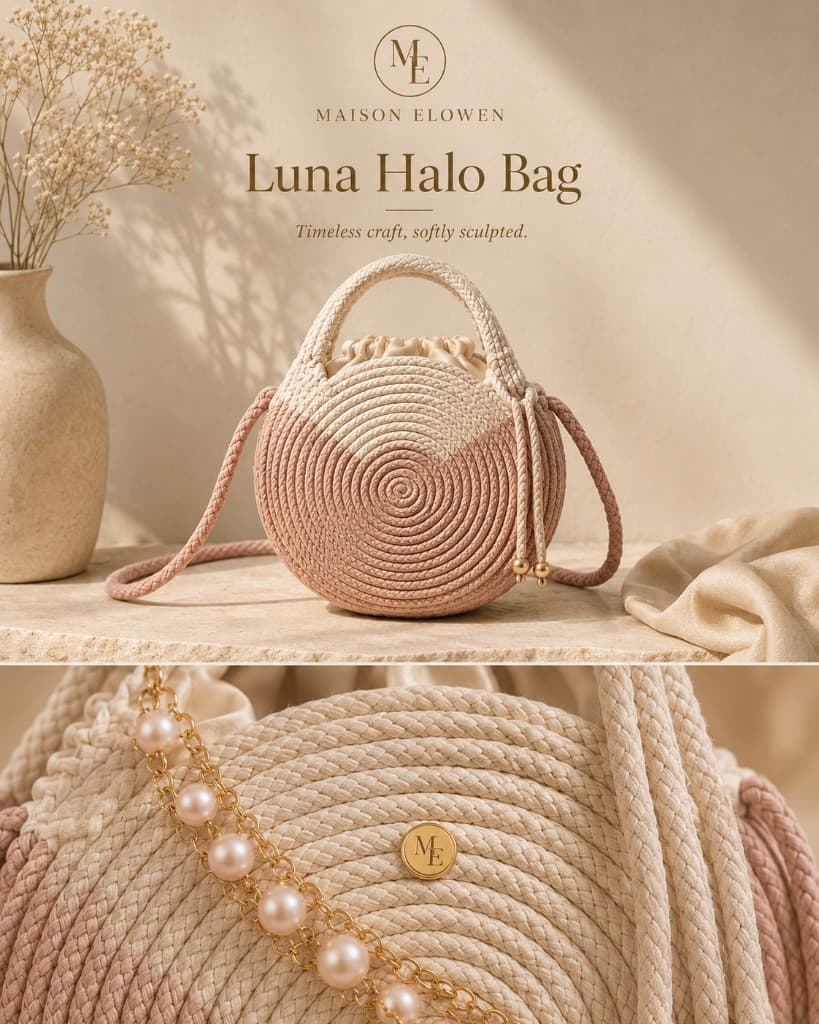
We build our woven shells from a single working length: the rope arrives as a line, and the bag leaves as a vessel. Between those two states is only coiling — no separate panels stitched into a disguise of weave. Each circumference is laid by hand onto the one below, so the wall is literally the record of how the strand was fed, pulled, and eased into place.
The foundation: first turns
The base is the slowest part of the work because error compounds upward. The opening spiral has to sit flat, centers have to agree, and the first few courses set the bias for the entire wall. If the coil wanders here — if one wind rides high or the center drifts — the correction is not a tweak later; it is undoing and re-seating until the floor tells the truth.
You learn to read the first turns the way a mason reads a footing: not as ornament, but as geometry that everything else inherits.
Tension along the strand
Coiling is not wrapping loosely and hoping glue will pretend it is tight. The rope has to be persuaded into each seat: enough pull to lock the new wind against its neighbor, never so much that the fiber complains or the wall cups. Tension is not a single dial — it shifts with diameter, with the angle of the opening as the form grows taller, and with the slight fatigue of the material through a long sitting.
That is why one artisan carries a piece from base to rim. Tension is a conversation between hand and rope; changing hands mid-conversation changes the accent.
The ridge as a clock
As courses stack, a rhythm appears on the surface: the ridge where two winds meet becomes a readable track of pace. Even spacing reads as calm; jitter reads as hurry. Experienced coilers stop measuring with rulers and start measuring with light — the way shadow falls across a ridge tells you whether the last pass matched the one before it.
Touch does the rest: the slight drag when a wind is shy, the hard edge when it is proud. The goal is not a photographable perfection on hour one; it is a wall that does not lie when you run your palm across it.
Closing the rim
The last passes are where the mouth of the bag is defined: diameter, lip, and the way the edge will meet handles or a facing. The coil has to finish honestly — no abrupt change in pitch that would read as a patch. We taper, tuck, or bind according to the pattern, always chasing the same rule that governed the base: the line should look as though it always knew where it was going.
That is the art of rope coiling — not a flourish laid on top of a product, but the product itself, turn by turn, until the line becomes a room you can carry.
Editorial · MAISON ELOWEN
← All journal entries